
THIRD TRANSNATIONAL ACTIVITY IN SKOPJE (NORTH MACEDONIA)

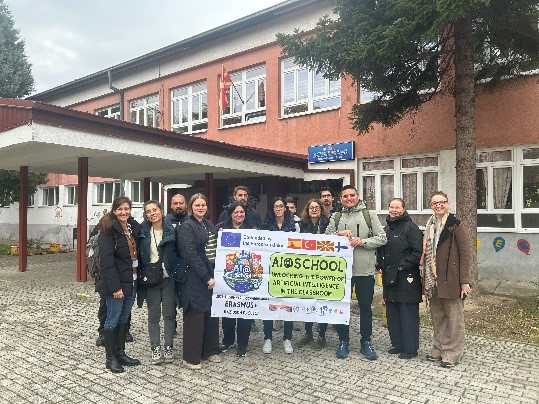
On the first day, following the warm welcome from the host school, OOU Naum Naumovski Borče, a visit to some of the classrooms and a tour of the school, a workshop was held to exchange experiences and good practices regarding the use of AI in the school environment, providing participants with an insight into the North Macedonian education system.
The following workshops focused on specific experiences and practical applications of AI in educational settings. In this regard, participants had the opportunity to discover, first-hand from its creator, an interesting and promising tool developed in North Macedonia by a maths teacher: an application called MisMath. MisMath is an AI-powered digital educational platform designed to facilitate the teaching and learning of mathematics.
Afterwards, various AI tools and ways of using them to personalise learning, reduce accessibility gaps and streamline teachers’ workloads were presented and discussed. These tools can help teachers address the needs of students requiring specific educational support more effectively, while also catering for the diverse needs of the classroom as a whole.
Following a lunch during which participants enjoyed some local cuisine, the afternoon was devoted to discovering the city of Skopje and learning more about the history of the nation of North Macedonia, including a guided tour of the Museum of the Macedonian Struggle for Independence.
The second day was entirely devoted to a range of cultural activities aimed at discovering the cultural and natural heritage of North Macedonia. These included a visit to Tetovo, particularly the Painted Mosque, and to the Orthodox Monastery of St. Naum, built between 900 and 905 AD, whose church is dedicated to St. John the Baptist. Its beautiful, immersive and spiritual acoustics offered the participating teachers the opportunity to listen to Byzantine chants performed as part of the Macedonian Orthodox rite, a musical tradition recognised by UNESCO as Intangible Cultural Heritage of Humanity.
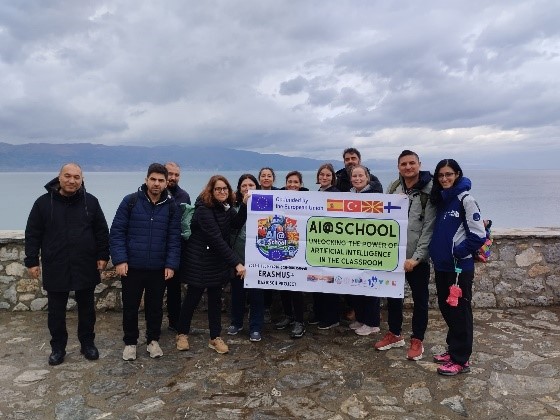
The next stops were the Bay of Bones, a reconstruction of an ancient prehistoric pile-dwelling settlement, and the city of Ohrid itself, known as the ‘Jerusalem of the Balkans’ and designated a UNESCO World Heritage Site for both its cultural and natural significance.
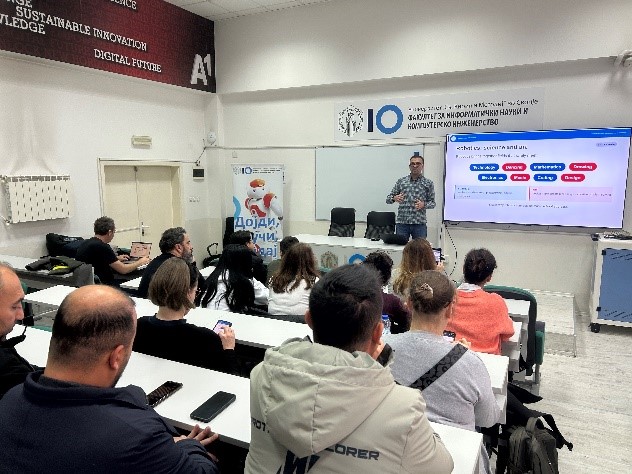
On the final day, the AI training programme continued with a visit to the Faculty of Computer Science and Engineering (FINKI) at Saints Cyril and Methodius University, where several projects incorporating artificial intelligence applications were presented. Participants also learned how AI is being integrated into the Robotics subject to develop different types of robots used in various fields of society. They were also able to see a real-life robot being operated using a remote control.
This was followed by a discussion on AI ethics and the ethical principles that should govern its use in primary and secondary education. Participants also attended a second presentation entitled ‘VEZILKA at School: AI for Teaching’.
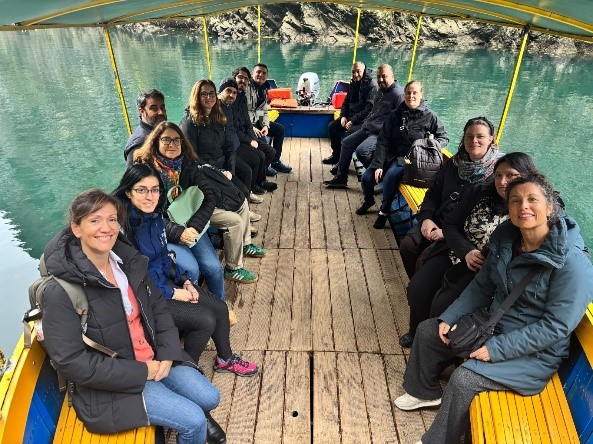
The day concluded with a visit to Matka Canyon, where participants enjoyed a boat trip to Vrelo Cave, the deepest explored underwater cave in the world. During the visit, teachers had the opportunity to use AI-powered applications, such as iNaturalist, to identify plants and animals along the canyon. The group also visited Macedonian Village (Makedonsko Selo), where they enjoyed a farewell lunch featuring traditional Macedonian cuisine.
IES Trevenque would like to express its sincere gratitude to the host school for its warm hospitality and friendliness throughout the visit. Now it is time to start preparing for the project’s next transnational activity, which will take place in La Zubia at the end of January.
FOR MORE INFORMATION ABOUT THE PROJECT, visit its website:
https://sites.google.com/view/aischool-erasmus-project/?pli=1

DICLAIMER
“Funded by the European Union. The views and opinions expressed are solely those of the author(s) and do not necessarily reflect those of the European Union or the Spanish Service for the Internationalisation of Education (SEPIE). Neither the European Union nor SEPIE can be held responsible for them.”
TERCERA ACTIVIDAD TRANSNACIONAL EN SKOPIE (MACEDONIA DEL NORTE)
En el primer día, tras el recibimiento del centro anfitrión, OOU Naum Naumovski Borče, la visita a algunas aulas y el recorrido por el centro, se realizó un taller de trabajo sobre intercambio de experiencias en el uso de la IA en el entorno escolar, acercándose al sistema educativo normacedonio. Los siguientes talleres se centraron en experiencias concretas en el uso de la IA en entornos educativos. En este sentido, los participantes pudieron conocer, de manos de su creador, una interesante y prometedora herramienta desarrollada en Macedonia por un profesor de matemáticas, una aplicación llamada MisMath. MisMath es una plataforma educativa digital impulsada por inteligencia artificial que está diseñada para facilitar la enseñanza y el aprendizaje de las matemáticas.
Después, se mostraron y discutieron distintas herramientas y formas de uso de la IA para personalizar el aprendizaje, reducir la brecha de accesibilidad y agilizar la labor docente, permitiendo atender de forma más eficaz tanto al alumnado con necesidades específicas de apoyo educativo (NEAE) como a la diversidad general del aula.
Tras un almuerzo donde se degustó comida local, la tarde estuvo dedicada a descubrir la ciudad de Skopie y profundizar en la historia de la nación de Macedonia del Norte, con la visita guiada al Museo de la Lucha de Macedonia por la Independencia.
La segunda jornada estuvo plenamente dedicada a varias actividades culturales para conocer el patrimonio cultural y natural de Macedonia del Norte. Éstas incluyeron la visita a Tetovo, concretamente a la Mezquita Pintada, al Monasterio ortodoxo de St. Naum, construido entre los años 900 y 905 y cuya iglesia está dedicada a San Juan Bautista. Su acústica envolvente y espiritual dio la oportunidad a los profesores participantes de escuchar el canto bizantino que se interpreta en el rito ortodoxo de Macedonia y que está reconocido por la UNESCO como Patrimonio Cultural Inmaterial de la Humanidad.
Las siguientes paradas fueron la Bahía de los Huesos, una reconstrucción de un antiguo asentamiento prehistórico de palafitos, y la propia ciudad de Ohrid, conocida como la ‘Jerusalén de los Balcanes’ y nombrada Patrimonio de la Humanidad por la UNESCO, tanto por su valor cultural como natural.
En la última jornada se continuó con la formación en IA con la visita a la Facultad de Ingeniería Informática (FINKI) de la Universidad Santos Cirilo y Metodio, donde se presentaron algunos proyectos que incorporan aplicaciones de inteligencia artificial. Los participantes también conocieron cómo se está implementado el uso de la IA en la asignatura de Robótica para conseguir diferentes robots que se usan en distintos campos de la sociedad y pudieron ver un robot en vivo controlado por un mando.
Posteriormente, se creó un debate sobre la ética de la IA y los principios éticos que deben regir su uso en educación primaria y secundaria y se recibió una segunda charla llamada ‘VEZILKA en la escuela: IA para la enseñanza’.
El día terminó con la visita al Cañón de Matka para dar un paseo en barco hasta la cueva kárstica de Vrelo, la cueva submarina más profunda explorada del mundo. Durante la visita, los profesores pudieron usar aplicaciones de IA (iNaturalist) para identificar plantas y animales a lo largo del cañón. Y también se visitó la Aldea Macedonia (Makedonsko Selo), donde se realizó un almuerzo con comida tradicional macedonia como despedida del grupo.
Desde el IES Trevenque queremos agradecer la hospitalidad y cercanía del centro anfitrión. Ahora toca prepararse para la próxima actividad transnacional del proyecto que tendrá lugar en La Zubia a finales de enero.
PARA MÁS INFORMACIÓN SOBRE EL PROYECTO, visita su página web: https://sites.google.com/view/aischool-erasmus-project/?pli=1

EXENCIÓN DE RESPONSABILIDAD
«Financiado por la Unión Europea. Las opiniones y puntos de vista expresados solo comprometen a su(s) autor(es) y no reflejan necesariamente los de la Unión Europea ni los del Servicio Español para la Internacionalización de la Educación (SEPIE). Ni la Unión Europea ni el SEPIE pueden ser considerados responsables de ellos.».